
You already manage the buildings. This runs the office.
Multi-owner portfolios, a real ledger, Ghanaian tax at source, and owner statements that come out of the system that billed the rent.
“Agent-free” does not mean you
Domicium is agent-free in one specific sense: nobody can stand between a landlord and a renter on the public marketplace and charge for the introduction. No viewing fees, no commission for opening a door. That rule is enforced by a database policy — can_list() — rather than by a paragraph in the terms.
A firm that manages property is a property manager, and property managers are a first-class role here. You can hold portfolios on behalf of owners, run their accounts, employ a team with separate permissions, bill a management fee, and publish vacancies for the owners who have appointed you. Everything on this page is built for exactly that.
The six things a managing office runs on
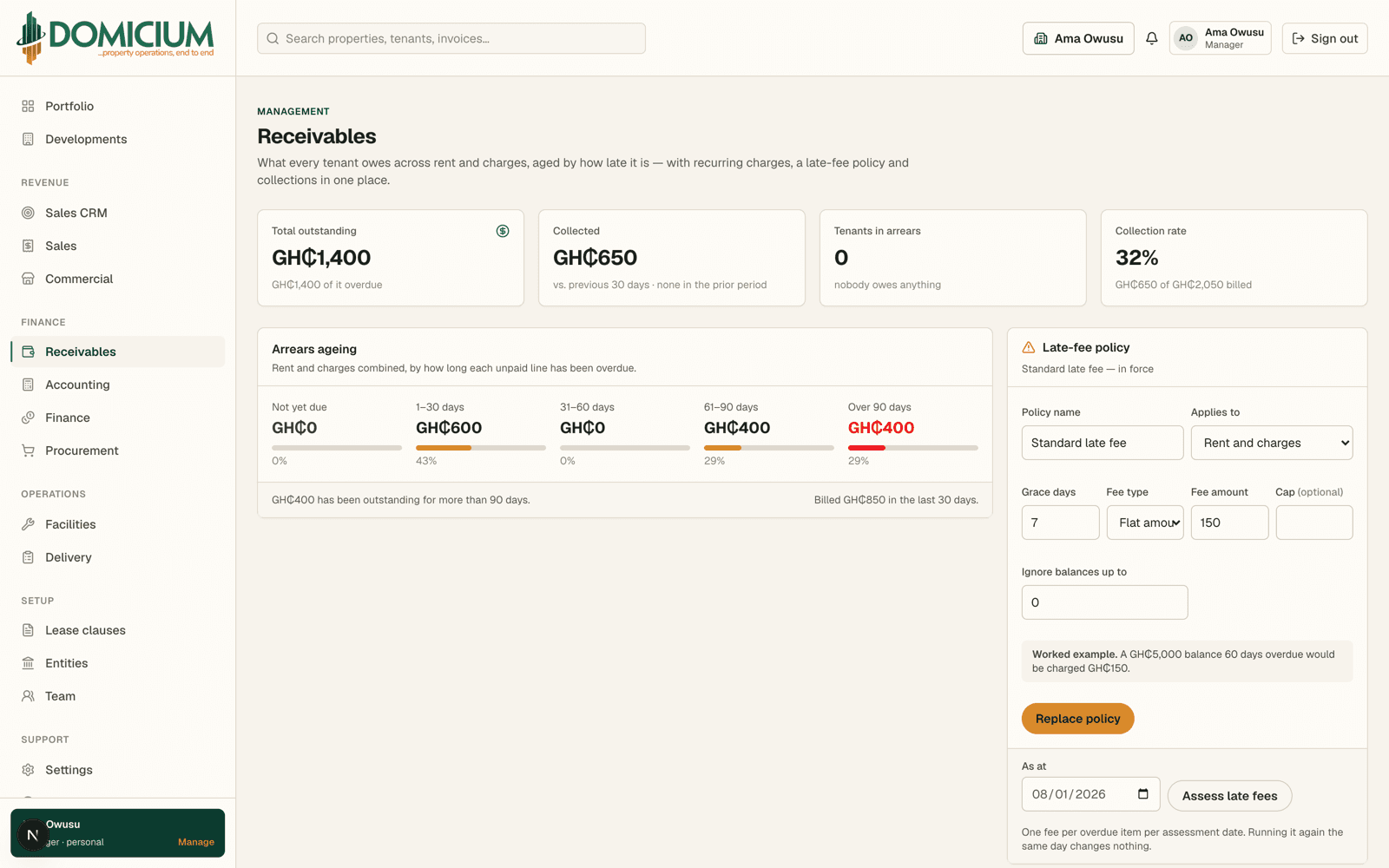
The arrears run, on a Tuesday morning
Every tenancy has a schedule generated from its own frequency — monthly, quarterly, annual, or the two-year advance that is still common here. What is due, what is late and by how long is a query, and the reminders go out without anybody remembering to send them.
Automated scoring proposes and a person disposes, throughout. No tenant is chased into a consequence by a machine: what the system does is order the queue and record what was decided.
You do not have to move everything at once
Most firms start with one building and a single month, run it in parallel with whatever they have now, and compare the two at the end. That is the honest way to evaluate an accounting system, and it is what the demo is for — we set up a property you actually manage rather than a sample one.
Opening balances, existing tenancies and outstanding arrears can be loaded. The effort involved is stated in the quote rather than discovered afterwards.
See it run one of your buildings
Forty minutes, your own portfolio, a written quote after. No card at any point.